Sidor

Visar inlägg med etikett Internet. Visa alla inlägg

tisdag 21 augusti 2012

Nakertamisesta palvelutoimintaan

2011-08-23 17.11.41_audio

KUVA: Helge V. Keitel, Kuopio

Tänään keskustelimme Kajaanissa “Nakertamisesta Palvelutoimintaan” –teemasta. Veli-Matti Karppinen kertoi 22.8.2012 kylätalon tapahtumasta, jossa www.nakertaja.net on pääosassa.

Nakertaja – Hetteenmäen kyläyhdistys ry. – oli Anna-Katriina Salmikankaan väitöskirjan (2004) aiheena: Salmikangas toi yhteissuunnittelun Kainuuseen.

Minua kiehtoo kehittämisen pitkä historia: Wiirilä Werkossa Wiikoittain on Nakertajaan verrattuna vasta teini-iässä.

lördag 9 januari 2010

Shanghai Expo 2010 after the Innovation train to Oulu

E71_24.10.2009_Sotkamo 128 There is life after the innovation train to Oulu. We’re already talking about the next step.

The Shanghai Expo 2010 is a possible destination. We need to talk about this goal during the trip to Oulu January 13, 2010.

We’ve a few months to arrange the journey and to find sponsors and financing. Finland is one of the countries exposing products, designs and services.

tisdag 26 augusti 2008

TechSoup by Sonja Kangas

TechSoup: "I am currently writing an article together with Dr. Outi Cavén-Pöysä on online youth cultures. More closely we will focus on motivation factors, trust and attitudes towards social networking. The article will be based on quantitative data from Japan, South Korea and Finland (2006-2007). We decided to focus on these three pioneer countries of the 1990s because at the end of 1990s SMS culture in Finland, iMode craze in Japan and online multiplayer gaming culture in South Korea were something different and never before seen. The article will study if these countries have special qualities to generate novel kind of internet cultures in future as well or would innovations develop anywhere regardless of the history?" Writes Sonja Kangas.

On her blog she tells about herself:
Name: Sonja Kangas
Location: Helsinki HC, Finland. Digital media and game enthusiast. Curious, excited and energetic.

"According to Paul Budde Communications the Internet is growing at a good rate, but the growth rate is not the same all over the world. The growth rate will not increase until broadband is further developed, and its price rates reduced. Will the Internet penetration have an effect on user innovations or the development of novel web cultures? How much does grass roots innovation, chance and cultural issues have to do with the development? Most likely we will not be able to offer answers to all of those question but I thought of sharing them with you anyhow."

Helge: We are friends on Facebook. I think I've seen the energetic Sonja on Jaiku, the microblogging site that has been down for several days while Google moves over Jaiku to its own servers. Google acquired Jaiku a year ago, if I remember right.

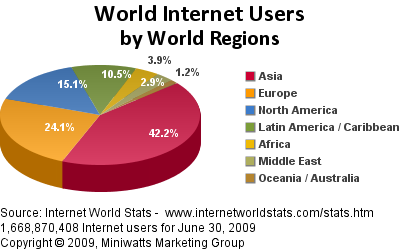
Sonja Kangas also reports, "According to InternetStats, the number of Internet users has more than doubled since the year 2000, and in 2007 there were over 1.1 billion people online worldwide. Web services have shaped youth cultures since mid 1990s, instant communication tools have introduced real time communication culture to masses. Web has also changed the way of working. New web2.0 companies and web service developers bring forward new services and solutions to be distributed potentially to the "whole world" at once."

tisdag 8 april 2008

The Truth According to Wikipedia

The Truth According to Wikipedia: "Dutch filmmaker IJsbrand van Veelen stirred a lot of controversy last week at the Next Web conference when he premiered the documentary above, The Truth About Wikipedia. It has now been posted to YouTube and is worth watching when you have a spare 45 minutes.

Helge: I've no time to listen to the YouTube now, but I will come back.

The film pits Andrew Keen, the disapproving author of The Culture of the Amateur, and Bob McHenry, former editor-in-chief of the Encyclopedia Britannica, against Wikipedia co-founders Larry Sanger, Jimmy Wales, and Web 2.0 guru Tim O’Reilly, among others. The film is masterfully made and shows many points of view, but it ends up being more than anything else a vehicle for Keen to put forth his diatribes against Wikipedia. You definitely get the sense that he wins the argument in the movie.

Helge: Wikipedia is a great show!

And, in fact, when I asked van Veelen afterwards on stage who he personally agreed with the most (I was the conference MC), he admitted it was Keen. This siding with the enemy, as it were, actually makes the documentary more thought-provoking. People in the audience were seething, and one man came prepared with a speech denouncing the filmmaker."

Helge: Hmmm! Jason Calacanis has been critical to Wikipeda...

In the film, Keen actually argues that we need gatekeepers for the truth, and those gatekeepers should be experts. Of course, he misses the point that the relatively small handful of people who do most of the writing and editing on Wikipedia may very well be experts in their topic areas, or become experts by writing and researching Wikipedia articles.

Helge: Gatekeepers of the truth should be experts! What is the value of Wikipedia? Is the truth coming in the hands of people?


torsdag 31 januari 2008

Net broken in India and Egypt

Net broken in India, Egypt [Reuters] - A breakdown in an international undersea cable network disrupted Internet links to Egypt, India and Gulf Arab countries on Wednesday, and Egypt said it could take several days for its services to return to normal. It was not immediately possible to gauge the impact of the disruption on financial institutions. Egypt's telecoms ministry said 70 percent of the country's Internet network was down and India initially said it had lost over half its bandwidth.

fredag 18 januari 2008

Compete Reports Fastest Moving Sites 2006-2007 -- Are the Numbers Correct? | CenterNetworks

Compete Reports Fastest Moving Sites 2006-2007 -- Are the Numbers Correct? | CenterNetworks: "Compete has a blog post today showing some of the fastest moving sites from December 2006 to December 2007. Many of the sites we've covered in the past are listed. On the positive side, sites include TechCrunch, CafeMom, Wordpress, LinkedIn, and Reddit. On the downside are sites including Vonage, Netscape and American Singles. I am shocked that Twitter isn't on the list with an Alexa of 600!

Written by Allen Stern - January 17, 2008

As an analytics freak, when I saw the report on TechCrunch, I immediately wondered how they got the percentage increases - for example, iamfreetonight, a startup covered on CN, is up 32,000%. They are a new site in 2007 so a large increase is probably more reasonable than say CafeMom which apparently grew 2,320%? My guess is that the percentages are missing a decimal place perhaps? In any event, the ranking is most likely correct so congrats to those listed!

They note, 'The chart above shows the top twenty sites that gained or lost the most amount of traffic from December 2006 to December 2007, as a percentage of visits in December 2006.'

Helge: I'll follow the post.

tisdag 20 november 2007

Internet Ten Years Ago

Tuesday, November 20, 2007


The picture to the left was used by me in a report ten years ago, 1997.

The statement "Futurists say that the Internet will radically alter global culture" is becoming reality.

  1. We Twitter
  2. We Jaiku
  3. We Facbook
  4. We Ning
  5. We Basecamp
  6. We Barcamp
  7. We Pownce
  8. We Blog
  9. We Microblog
  10. We Skype
  11. We YouTube
  12. We Podcast
  13. We Webcast
  14. We Collaborate online
  15. Internet has become a communication work horse
Ten years ago email was the killer application. Today its a spam-machine.

Ten years ago a web-page was a huge step forward. It was your business card.

Today I blog on several channels on a daily basis.

måndag 19 november 2007

The Impact of Language Variety and Expertise on Perceptions of Online Political Discussions

The Impact of Language Variety and Expertise on Perceptions of Online Political Discussions: "The growth of the Internet has fostered hopes that it will promote active democracies around the world. These hopes are based on the multiple sources of information available to users on the Internet, which is believed to lead to better political choices, and the freedom to express one's views online, regardless of social status differences.

However, the Internet also hosts various forms of deviant behavior, such as flaming of other discussants, malicious spreading of falsehoods, and hacking into private networks. These harmful acts may instead inhibit widespread participation and deliberation."

Helge: The Mikkeli Social Learning Seminar is a good example of what an initilly small crowd of 80 people is capable of doing. It wasn't an ordinary seminar with start and ending. The seminar continues to produce ideas and practical extensions of the ideas and findings of the seminar. I'm proud to be a part of that team.


söndag 4 november 2007

Ten years ago about Internet Direct

Since 1990s, when Finland became a global player in technology, many international companies have collaborated with Finnish firms and research institutions, and we've learned to work together with many nationalities.

However, to get the most out of cooperation with Finns, it might be desirable to know something about our business and cultural customs and traditions.


Finns highly appreciate punctuality, planning far ahead and following deadlines. One of the reasons behind that is due to the extremely cold winter weather. Being schedule-conscious and able to plan ahead has long been a matter of survival.

We Finns are generally most comfortable when we can focus on task until completion. Relationships are not prioritized in the work context as in some other cultures. Finns might start a project together and upon completion will go out together to eat. In France or Italy, for instance, partners would start by eating together and then work on the project. Because they believe a good relationship makes the project work more smoothly.

The quantity of oral communication is often minimal. Finns often say things in the shortest way possible.

In many cultures, interactive information gathering is the norm, where the person will ask direct questions (Who are you? What are you doing? Where are you from? etc) to get the desired information. A Finn would rather get the information by observation and not asking too many questions.